Mobile App Development Company: What Businesses Should Look for Before Hiring One
You have an app idea. Maybe it started as a rough sketch, a conversation with your team, or a problem you noticed in your business. Then comes the harder question: who should actually build it?
Choosing a mobile app development company can feel surprisingly difficult. Most companies will tell you they can build Android and iOS apps. Many will show polished screenshots. Almost everyone has a list of technologies they work with.
That does not necessarily tell you whether they are the right partner for your project.
The better question is what happens behind those screenshots. How does the team understand your requirements? How do they choose the technology? Who handles the backend, testing and deployment? What happens when something changes after launch?
Those details tend to matter much more than a long list of services.
What does a mobile app development company actually do?
A mobile app development company is usually involved in much more than writing the code for an application.
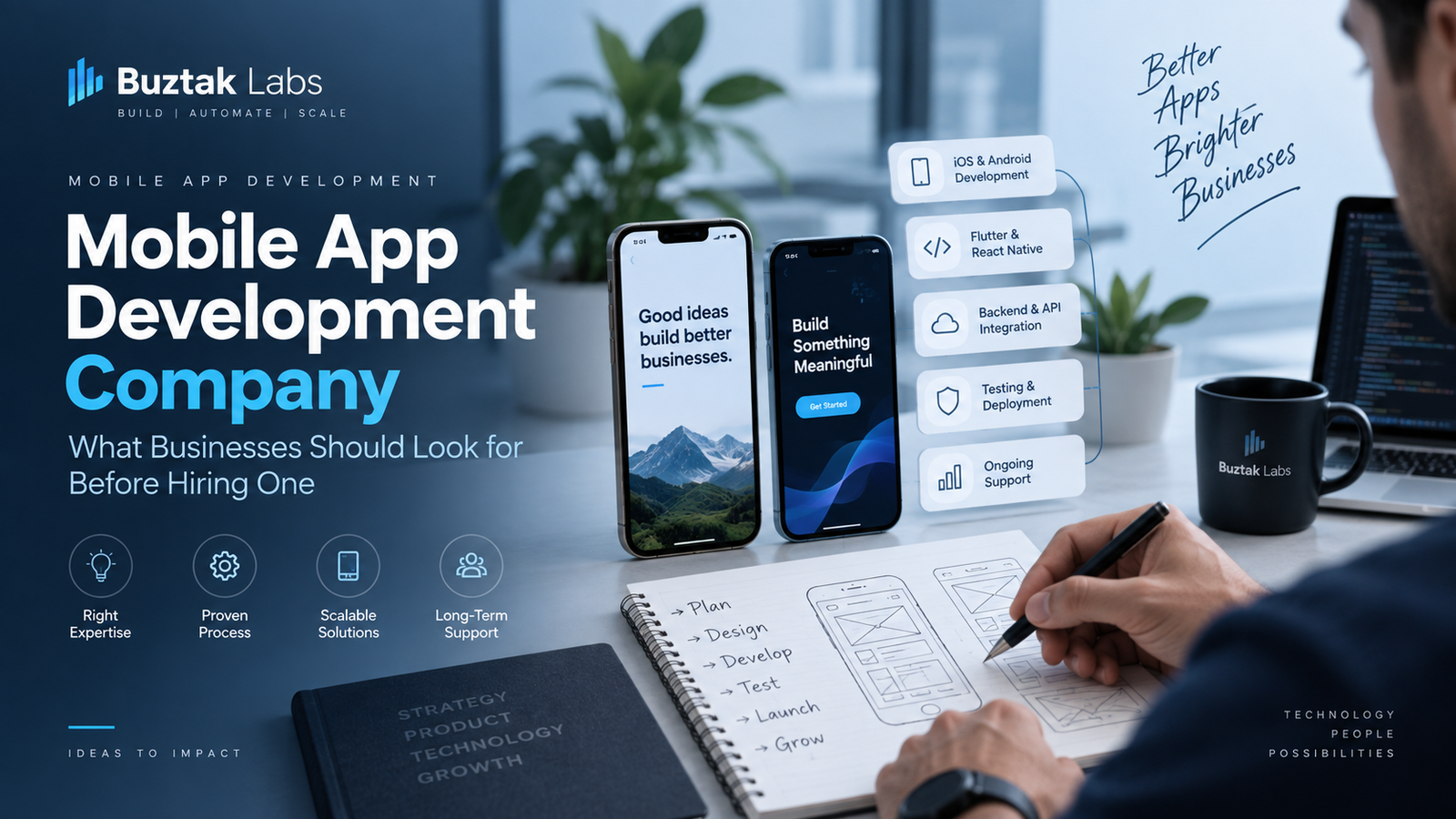
Depending on the project, the work can include understanding the product requirements, planning the user experience, designing the interface, developing the mobile application, connecting it with backend systems and APIs, testing the application, preparing it for release and supporting it after launch.
The exact scope varies from project to project.
A relatively simple business application may have a straightforward feature set. A larger product could require user accounts, payments, notifications, location services, third-party integrations, an administrative panel and a backend capable of handling changing demand.
That is why it is worth discussing the complete product before discussing development alone.
How to evaluate a mobile app development company
A company may have talented developers and still not be the right fit for your application. The real test is whether its approach matches what you are trying to build.
Start with relevant experience
Look at the company's actual work.
A portfolio can tell you more than a page filled with technology names. Look for projects that have some meaningful connection with your requirements, whether that is the type of application, the complexity of the product, the target users or the technical challenges involved.
You do not necessarily need a company that has built the exact same application before. What matters is whether the team can explain the decisions behind its previous work.
Ask what they built, what their role was and what technologies were involved.
If the portfolio consists only of attractive screenshots with little explanation, ask more questions.
Look beyond the mobile interface
A mobile application is often only one part of a larger system.
Many applications need a backend, database, APIs, authentication, notifications, payment integration, analytics or an administrative interface. If these pieces are being developed by different teams without proper coordination, problems can appear later.
A capable mobile app development company should be able to explain how the mobile application fits into the wider technical architecture.
This is particularly important when your application needs to communicate with an existing website, CRM, business system or third-party service.
Pay attention to the development process
Ask what happens after the initial discussion.
A sensible process usually starts with understanding the product and its requirements before development moves too far ahead. UI and UX decisions should be considered before developers are expected to turn unfinished ideas into screens.
You should also know how progress will be demonstrated, how changes are handled and who makes technical decisions.
A development process does not have to be complicated. It does need to be understandable.
Native or cross-platform: which approach makes sense?
Technology selection should follow the application requirements, not the other way around.
For native development, iOS applications are commonly built using Apple's development technologies, while Android applications use Google's Android development ecosystem. Native development can make sense when an application depends heavily on platform-specific capabilities or requires particularly close control over a specific operating system.
Cross-platform development takes a different approach. Frameworks such as Flutter and React Native can allow teams to share significant portions of development across iOS and Android.
Neither approach is automatically better for every project.
If your product needs specialised device capabilities, complex platform-specific behaviour or intensive performance requirements, native development may be appropriate. If you want to build for both platforms while sharing more of the codebase, a cross-platform approach may be worth considering.
The right question is not, "Which technology is the best?"
It is:
"Which technology is appropriate for this particular product?"
A good development partner should be able to explain that decision rather than simply recommending the technology it happens to use most often.
Do not overlook backend and API development
This is an easy part of an app project to underestimate.
The application users see on their phones may depend on a considerable amount of work happening elsewhere. Data may need to move between the mobile application, backend services, databases and external APIs.
For example, a business application might need to authenticate users, retrieve account information, process transactions and send notifications. The mobile interface is only one part of that system.
Ask your prospective development partner how these components will work together.
You should also clarify who is responsible for backend development, hosting, integrations and future changes. A beautifully designed mobile application will not solve much if the underlying system has not been planned properly.
Testing should be part of development, not an afterthought
An application can look perfect during a demonstration and still have problems on real devices.
Different screen sizes, operating system versions, network conditions, permissions and device capabilities can all affect how an app behaves. Testing therefore needs to happen throughout development rather than being left until the day before launch.
Google's Android documentation also treats testable architecture as an important part of building maintainable applications, while Apple's App Store guidance asks developers to test applications for crashes and bugs before submission.
Ask the development company:
- How do you test the application?
- Which devices and operating system versions are considered?
- How are bugs tracked and resolved?
- Who performs final acceptance testing?
- What happens when a problem is discovered after release?
You do not need a complicated answer. You need a clear one.
App Store and Google Play submission are part of the project
Getting an application built is not necessarily the final step.
Apple reviews applications and updates before they are made available through the App Store, and its current guidance specifically highlights issues such as crashes, incomplete functionality, inaccurate metadata and inaccessible backend services.
That means store preparation should be considered during development rather than treated as a last-minute administrative task.
Ask who will handle:
- Store configuration
- Application metadata
- Screenshots and descriptions
- Release builds
- Submission
- Review-related issues
- Updates after launch
It is worth knowing who owns this part of the process before development begins.
Ask how the company handles changes
Requirements often change.
Sometimes the reason is simple. You understand the product better after seeing the first working version. A feature that sounded essential turns out to be unnecessary. Another feature becomes more important after users test the application.
This is normal.
The problem comes when neither side has agreed on how changes will be handled.
Before development starts, understand what is included in the agreed scope and what happens when you request something outside it. A clear process protects both the client and the development team.
What should you ask before hiring a mobile app development company?
A first conversation with a development company does not need to be a technical interview.
A few practical questions can reveal a lot:
Can you show me relevant applications you have actually developed?
This helps you understand the team's real experience.
Who will work on my project?
Know whether you are speaking with the people who will actually build the application or only with a sales representative.
How will you decide between native and cross-platform development?
The explanation is often more useful than the answer itself.
What is included beyond the mobile application?
Ask about backend development, APIs, integrations, testing, deployment and administration.
How will I review progress?
You should have a reasonable way to see what is being built before everything is finished.
What happens after launch?
Clarify maintenance, bug fixes, updates and future development.
These questions are simple, but they can prevent difficult conversations later.
Look at the portfolio, not just the promise
When comparing mobile app development companies, spend time with their portfolio.
Look for evidence of actual development work rather than only design concepts. If a company can explain the problem behind a project, the decisions made during development and the role its team played, you get a much better sense of its capabilities.
This is also where a company's portfolio can help you judge whether its experience is relevant to your project.
At Buztak Labs, mobile app development is one of the services we provide, and our portfolio gives prospective clients an opportunity to see the kind of application work we have undertaken. As more projects are added, the portfolio can provide a more useful picture of the technologies, product types and development capabilities behind the service.
What about mobile app development cost?
There is no useful single price for mobile app development.
The cost depends on what you are building and how it needs to work.
A simple application with a limited number of screens is very different from a product involving user accounts, payments, real-time functionality, third-party integrations, complex backend systems or multiple user roles.
Technology choice can influence the development effort as well. So can UI and UX requirements, testing, integrations, infrastructure and ongoing maintenance.
When comparing proposals, look beyond the headline number.
Ask what the estimate actually includes.
A lower quote can become much less attractive if important parts of the project are excluded and have to be added later.
Choosing the right partner is about fit
There is no single mobile app development company that is automatically right for every business.
A startup building its first MVP may have very different requirements from an established company extending an existing digital product. An application built around specialised hardware may need a different technical approach from a straightforward customer-facing business app.
The right development partner should understand those differences.
Before signing a contract, make sure you are comfortable with the team's technical approach, communication process, project scope, testing strategy, ownership arrangements and plans for after launch.
And take a close look at the work they have already done.
A good mobile application starts long before the first line of code. It starts with choosing the right problem to solve, understanding the product clearly and working with a team that can turn that understanding into something people can actually use.
Frequently Asked Questions
How do I choose a mobile app development company?
Start by reviewing relevant portfolio work, understanding the team's development process, checking its technical capabilities and asking who will handle design, development, backend integration, testing and deployment. The best choice depends on the requirements of your particular application.
Should I choose native or cross-platform mobile app development?
It depends on the application. Native development can be suitable when platform-specific functionality or performance is a major requirement. Cross-platform frameworks such as Flutter and React Native can be useful when a business wants to develop for multiple platforms while sharing more of the codebase.
What should a mobile app development company provide besides coding?
Depending on the project, services may include product planning, UI/UX design, backend development, API integration, testing, deployment and post-launch maintenance. Confirm the exact scope before development begins.
How much does mobile app development cost?
There is no standard cost because applications differ significantly in complexity. Features, platforms, design requirements, backend systems, integrations, testing and ongoing support can all affect the overall project cost.
How long does it take to develop a mobile application?
The timeline depends on the scope and complexity of the product. A small application may require substantially less development time than a platform with multiple user roles, integrations, payments or real-time functionality. A proper requirement assessment is needed before giving a meaningful estimate.
Why is testing important before launching a mobile app?
Testing helps identify crashes, functional problems, usability issues and device or operating system compatibility problems before users encounter them. Both Google and Apple provide developer guidance that emphasises testing and application quality before release.
A practical way to start
If you are planning a mobile application, begin by writing down what the application needs to accomplish rather than starting with a technology choice.
Define the users, the main problem, the essential features and the platforms you need to support. Then speak with development teams and ask them to explain how they would approach the product.
The right conversation should leave you with a clearer understanding of the project, not just a quotation.
For businesses evaluating a mobile app development company, that is probably the most useful sign of all.